Hajj is performed over five or six days, from the 8th to the 12th or 13th of Dhul Hijjah. Most pilgrims from Bangladesh perform Hajj al-Tamattu': an Umrah first, then leaving Ihram and entering it again for Hajj on the 8th. This guide follows that order. The Prophet ﷺ said, “Take your rites from me” (Muslim), so each step below follows his Hajj.
The three types of Hajj
- Tamattu': Umrah in the Hajj months, release from Ihram, then a new Ihram for Hajj. A sacrifice (hady) is required. This is the type most Bangladeshi pilgrims perform.
- Qiran: Umrah and Hajj in one Ihram without a break. A sacrifice is required.
- Ifrad: Hajj only. No sacrifice is required.
Before the days of Hajj
Pilgrims usually arrive in Saudi Arabia two to four weeks early. You perform your Umrah (see our Umrah guide), leave Ihram, and spend the days in prayer, Qur'an and dhikr. The first ten days of Dhul Hijjah are the best days of the year, so increase your takbir: Allāhu akbar, Allāhu akbar, lā ilāha illallāh, wallāhu akbar, Allāhu akbar wa lillāhil-ḥamd.
Day 1 — 8 Dhul Hijjah (Yawm al-Tarwiyah): to Mina
- Take a ghusl, put on Ihram where you are staying, and make the intention: Labbayk Allāhumma ḥajjan. Then begin the Talbiyah.
- Travel to Mina, usually by group bus in the morning.
- Pray Dhuhr, Asr, Maghrib, Isha and the next Fajr in Mina, each at its own time. Shorten the four-rak'ah prayers to two, but do not combine them.
Day 2 — 9 Dhul Hijjah: the Day of Arafah
This is the heart of Hajj. The Prophet ﷺ said, “Hajj is Arafah.” Missing it means missing Hajj.
- After sunrise, move to Arafat. Make sure your group's tents are inside the boundary of Arafat. Signs mark it.
- At Dhuhr time, pray Dhuhr and Asr together, two rak'ahs each, with one adhan and two iqamahs.
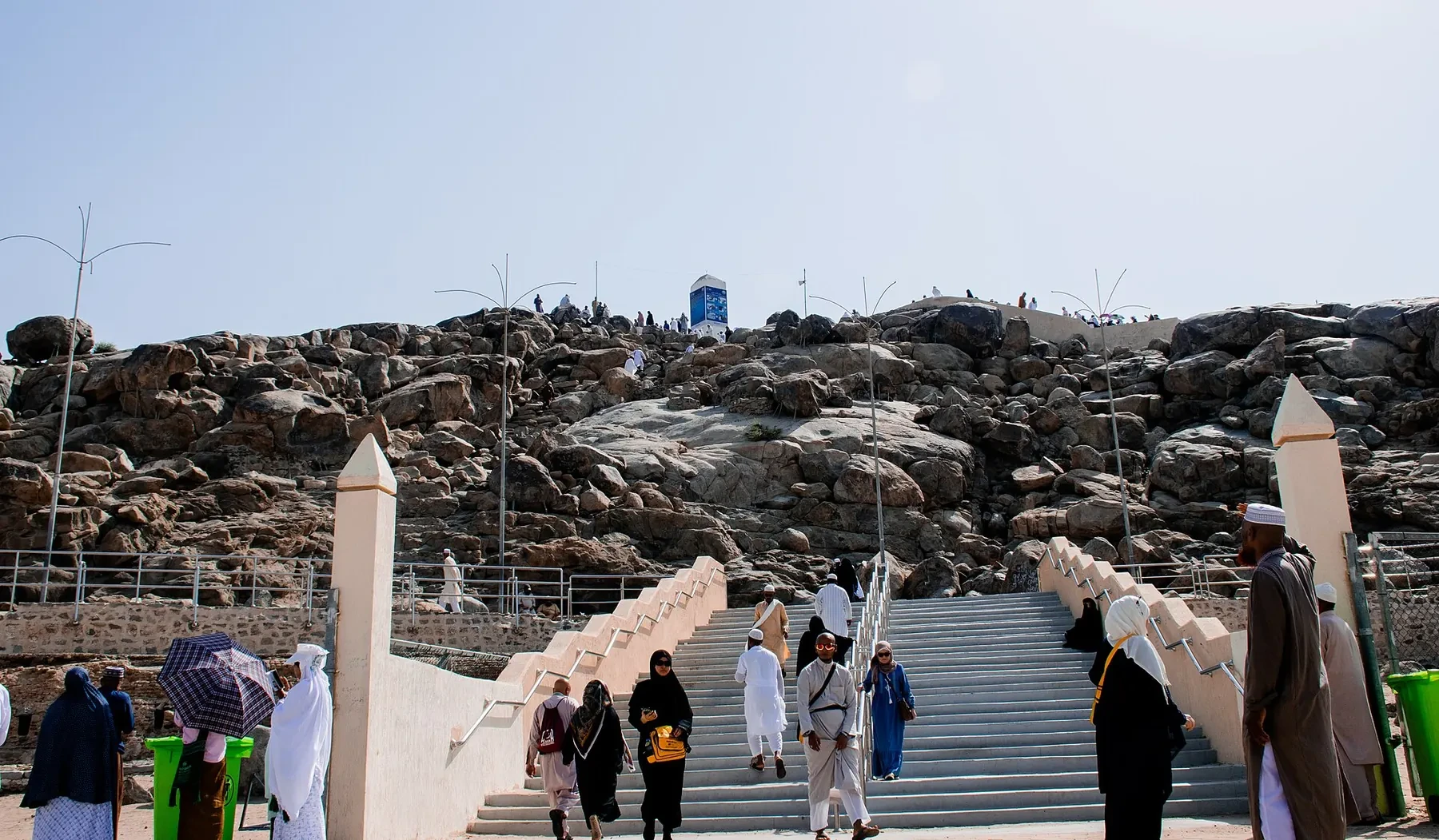
- Spend the afternoon until sunset facing the qiblah, with your hands raised in du'a. The best du'a is: lā ilāha illallāhu waḥdahu lā sharīka lah, lahul-mulku wa lahul-ḥamd, wa huwa ‘alā kulli shay'in qadīr. Ask for yourself, your family and the Ummah. Climbing Jabal al-Rahmah is not part of the Sunnah.
- Do not leave Arafat before sunset.
The night of the 10th: Muzdalifah
- After sunset, travel calmly to Muzdalifah. When you arrive, pray Maghrib (three rak'ahs) and Isha (two) together.
- Sleep. The Prophet ﷺ rested this night and did not stay up in worship.
- Pray Fajr early, then remember Allah and make du'a facing the qiblah until the sky is bright.
- The weak, the elderly, women and those caring for them may leave for Mina after midnight. This permission is based on the hadith of Asma' and Sawdah (RA).
- Pick up seven pebbles, a little bigger than chickpeas, for the next morning. You can collect the rest in Mina.
Day 3 — 10 Dhul Hijjah (Yawm al-Nahr, Eid)
The busiest day of Hajj has four acts. The Sunnah order is below, but changing the order is allowed. When asked about it on this day, the Prophet ﷺ said, “Do it, there is no harm.”
- Stone Jamrat al-Aqabah (the large pillar) with seven pebbles, one at a time, saying Allāhu akbar with each throw. Stop the Talbiyah when you begin.
- Sacrifice (for Tamattu' and Qiran). It is normally arranged through the official Adahi programme, and your agency confirms the time.
- Shave or trim the hair. Men shaving is better. After the stoning and shaving you are in the first release (tahallul): everything except marital relations becomes allowed, and you may wear normal clothes.
- Tawaf al-Ifadah and the Sa'i of Hajj in Makkah. They can be done on the 10th or later in the days of Tashreeq. After them, all restrictions end.
Days 4–5 (and 6) — 11, 12 and 13 Dhul Hijjah: the days of Tashreeq
- Spend the nights (most of each night) in Mina.
- Each day, after the sun passes its zenith (after Dhuhr time begins), stone all three Jamarat in order: the small, then the middle, then the large, seven pebbles each.
- After the small and the middle Jamarah, step aside, face the qiblah and make a long du'a. There is no du'a after the large one.
- If you want to leave early, stone on the 12th and leave Mina before sunset. Otherwise, stay and stone again on the 13th. Allah says: “Whoever hastens in two days, there is no sin on him; and whoever delays, there is no sin on him” (2:203).
- The elderly and the sick may appoint someone to stone on their behalf.
Farewell Tawaf (Tawaf al-Wada')
Your last act in Makkah, just before you leave the city, is a farewell Tawaf of seven circuits without Sa'i. Women who are menstruating are excused from it.
Practical tips from our guides
- Walking is unavoidable. Break in comfortable sandals before you travel and carry a small foldable mat.
- Drink water constantly, use an umbrella, and rest between acts of worship. The heat is the biggest danger.
- Wear your group card and hotel card at all times, and save your group leader's number.
- Guard your tongue and your patience. Crowds test character, and Allah says there is “no obscenity, no wickedness and no quarrelling in Hajj” (2:197).
Every Rizqan Hajj 2027 package includes district orientation, a full training day and a guide with your group on every one of these days.