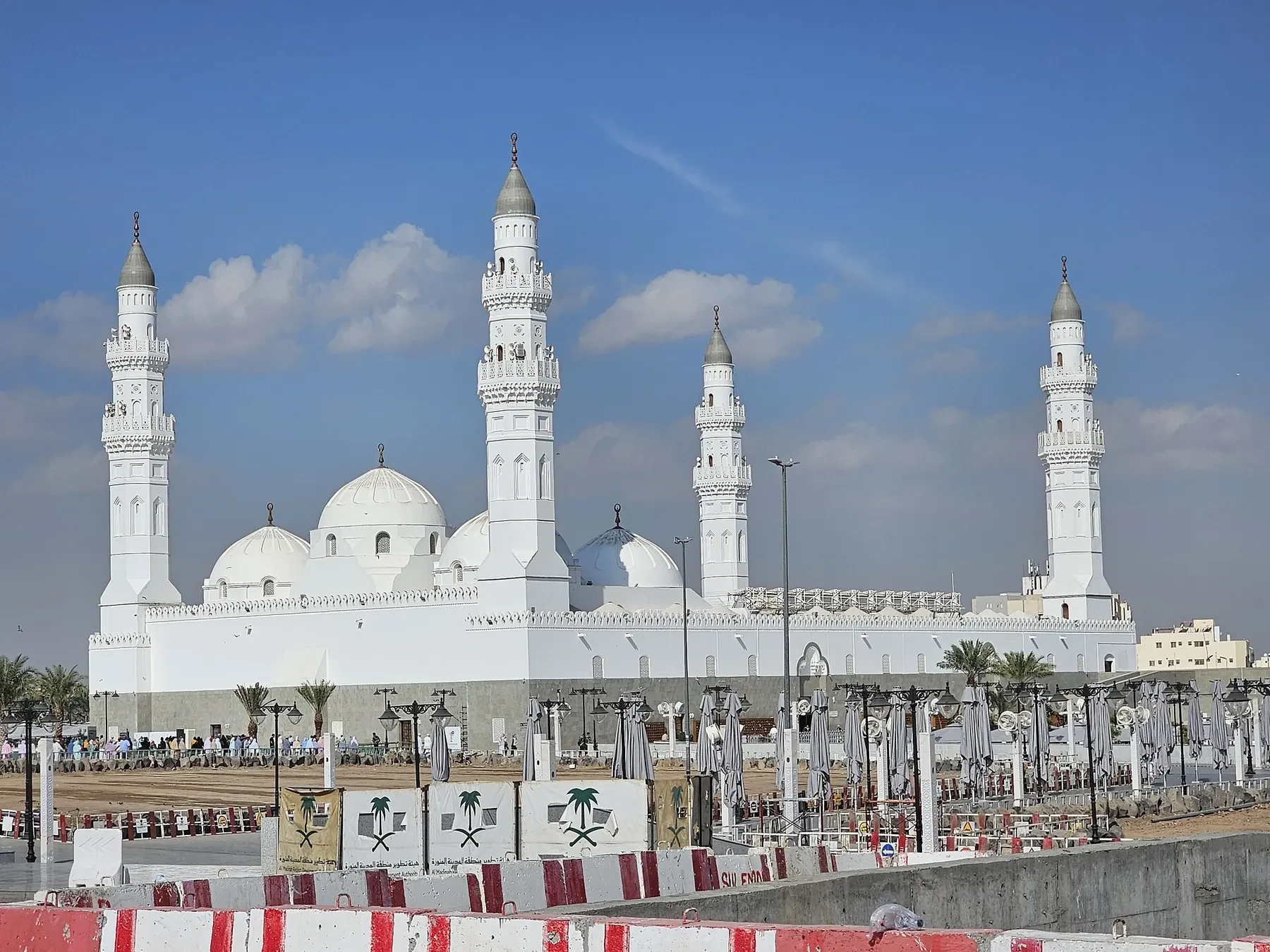
About three kilometres south of Masjid an-Nabawi stands a bright white mosque with four tall minarets. Masjid Quba was the first mosque built in Islam, and the Prophet ﷺ laid its first stones with his own hands. For pilgrims in Madinah, a visit is one of the easiest and most rewarding acts of the trip.
A mosque from the first days of the Hijrah
When the Prophet ﷺ and Abu Bakr (RA) completed their migration from Makkah in 622 CE, they first stopped at Quba, a village of orchards on the edge of Madinah where the clan of Banu Amr ibn Awf lived. He stayed there for several days, and in that time he founded a mosque. He set the direction of prayer, carried stones, and the Companions built around him. It was the first place in Islam built only for the congregation to worship Allah together.
Praised in the Qur'an
Allah says:
“A mosque founded on righteousness from the first day is more worthy for you to stand in. Within it are men who love to purify themselves, and Allah loves those who purify themselves.” (Surah At-Tawbah 9:108)
Many commentators say the verse refers to Masjid Quba. Others apply it to Masjid an-Nabawi as well, and both were founded on taqwa. When the Prophet ﷺ asked the people of Quba about the purification for which Allah praised them, they explained that they washed with water after relieving themselves.
The reward of an Umrah
The Prophet ﷺ said:
“Whoever purifies himself in his house, then comes to Masjid Quba and prays in it, will have a reward like that of an Umrah.” (Ibn Majah, graded authentic)
Note the detail: the wudu is made at home, or at your hotel, and then you go to Quba with the intention of praying there. Ibn Umar (RA) also reported that “the Prophet ﷺ used to visit Quba every Saturday, walking or riding, and pray two rak'ahs there.” (Bukhari and Muslim). Many pilgrims follow this Sunnah and go on a Saturday morning.
The mosque today
The mosque has been rebuilt and enlarged many times over the centuries. The present building dates from the 1980s, designed by the Egyptian architect Abdel-Wahed El-Wakil, with white walls, rows of domes and four minarets. A major expansion announced in 2022 aims to increase its area and capacity many times over, together with the surrounding gardens and services.
The Quba walkway
A wide, shaded pedestrian avenue of about three kilometres links Masjid an-Nabawi with Masjid Quba, close to the route the Prophet ﷺ is said to have taken. Walking it after Fajr or in the cool of the evening is a lovely way to follow his Saturday Sunnah. There are cafés, benches and water along the way. If walking is hard, a taxi takes about ten minutes.
Tips for your visit
- Make wudu at your hotel before leaving, to earn the reward in the hadith.
- Pray at least two rak'ahs. There is no other special act at Quba.
- Women have a separate entrance and prayer hall, clearly signed.
- Combine your visit with Masjid al-Qiblatayn and the date farms nearby. Both are on our Madinah Ziyarah route.
Masjid Quba is included in the Madinah Ziyarah on every Rizqan Umrah package and Hajj package. See all the Ziyarah sites we visit.