Umrah has only four essential parts: Ihram, Tawaf, Sa'i and Halq or Taqsir. Most pilgrims complete it within three to four hours of reaching their hotel in Makkah. It is simple, but the details matter, and the most common mistakes come from following habits instead of the Sunnah. This guide walks you through each step in order.
1. Before you leave home
Make a sincere intention that you are travelling for Allah alone. Repent, settle debts or tell your family about them, and ask forgiveness from anyone you have wronged. Learn the rites before you go. Rizqan pilgrims attend a pre-departure training for this reason.
- Men: two plain, unstitched white sheets (izar and rida), sandals that leave the ankle and the top of the foot uncovered, and a belt or pouch if needed.
- Women: ordinary modest clothing in any plain colour. There is no special Ihram garment for women. In Ihram a woman does not wear a niqab or gloves, but she covers her face from non-mahram men with her scarf or outer garment when needed.
2. Ihram and the Miqat
Ihram is the state you enter with the intention of Umrah. You must enter it before crossing the Miqat, the boundary the Prophet ﷺ set for each direction of travel.
- Flying from Dhaka to Jeddah: the plane crosses the Miqat roughly 30–40 minutes before landing, and the crew usually announces it. Most pilgrims take a ghusl at home, put on the Ihram garments at Dhaka airport or on board, and make the intention when the Miqat is announced.
- Going to Madinah first: you enter Ihram later, at Dhul-Hulayfah (Abyar Ali), on the road from Madinah to Makkah.
Before Ihram, take a ghusl, trim the nails and remove unwanted hair if needed. Men may perfume the body (not the Ihram cloth). Then make the intention:
لَبَّيْكَ اللَّهُمَّ عُمْرَةً
Labbayk Allāhumma ‘umrah: “Here I am, O Allah, for Umrah.” Then begin the Talbiyah, men aloud and women quietly:
لَبَّيْكَ اللَّهُمَّ لَبَّيْكَ، لَبَّيْكَ لَا شَرِيكَ لَكَ لَبَّيْكَ، إِنَّ الْحَمْدَ وَالنِّعْمَةَ لَكَ وَالْمُلْكَ، لَا شَرِيكَ لَكَ
If you fear you may not be able to finish because of illness or another obstacle, you may add: “fa in ḥabasanī ḥābis, fa maḥillī ḥaythu ḥabastanī”, meaning “if anything prevents me, I will leave Ihram where I am prevented.”
What becomes forbidden in Ihram
- Cutting hair or nails, and applying perfume
- Marital relations and anything leading to them, and proposing or contracting marriage
- Hunting land animals
- For men: stitched, fitted clothing and covering the head
- For women: niqab and gloves
Arguing, foul speech and sin are always forbidden, but they are worse in Ihram. Keep your tongue busy with the Talbiyah.
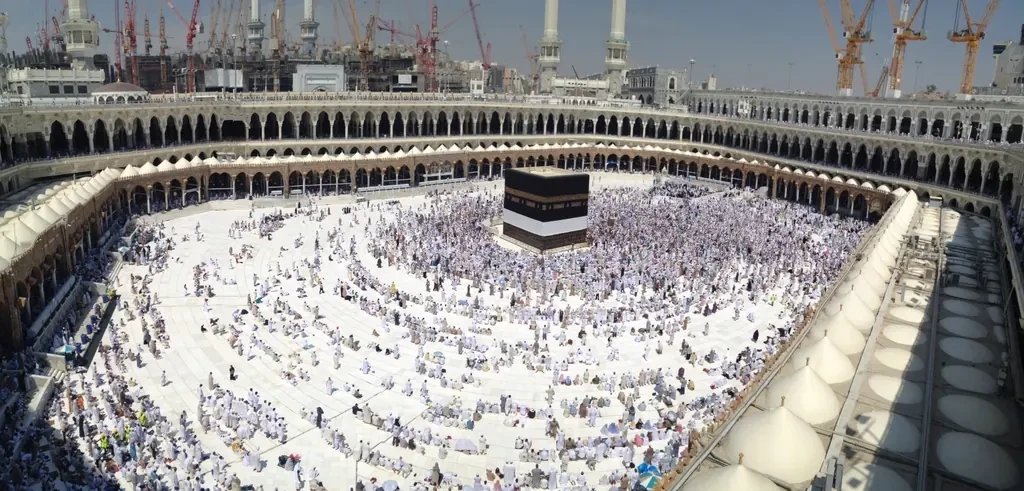
3. Tawaf: seven circuits around the Ka'bah
Enter Masjid al-Haram with your right foot and say the du'a for entering a mosque. Stop the Talbiyah when you begin Tawaf. You must be in a state of wudu.
- Idtiba' (men): pass the upper sheet under your right arm so that the right shoulder is bare. Do this only during this Tawaf.
- Start at the Black Stone (al-Hajar al-Aswad), marked by a line of brown tiles or a green light on the wall. Face it, and touch and kiss it if you can do so without pushing. Otherwise, raise your right hand towards it once and say “Bismillāh, Allāhu akbar”.
- Walk counter-clockwise with the Ka'bah on your left, for seven full circuits, each one starting and ending at the Black Stone.
- Raml (men): in the first three circuits, walk briskly with short steps if the crowd allows. Walk normally in the last four.
- At the Yemeni Corner (the corner before the Black Stone), touch it with your right hand if possible. Do not kiss it or point at it. Between it and the Black Stone, recite:
رَبَّنَا آتِنَا فِي الدُّنْيَا حَسَنَةً وَفِي الْآخِرَةِ حَسَنَةً وَقِنَا عَذَابَ النَّارِ
There is no fixed du'a for each circuit. The small booklets with “the du'a of the third round” have no basis in the Sunnah. Make du'a in your own language, recite Qur'an and remember Allah.
The two rak'ahs and Zamzam
After the seventh circuit, cover your right shoulder. Recite “wattakhidhū min maqāmi Ibrāhīma muṣallā” (2:125) and pray two short rak'ahs behind Maqam Ibrahim if there is room, or anywhere in the mosque. The Sunnah is to recite Surah al-Kafirun in the first rak'ah and Surah al-Ikhlas in the second. Then drink Zamzam and make du'a.
4. Sa'i between Safa and Marwah
Go to the hill of Safa. As you approach it, recite:
إِنَّ الصَّفَا وَالْمَرْوَةَ مِنْ شَعَائِرِ اللَّهِ — أَبْدَأُ بِمَا بَدَأَ اللَّهُ بِهِ
“Indeed Safa and Marwah are among the symbols of Allah. I begin with what Allah began with.” Climb until you can see the Ka'bah, face it, raise your hands, and say three times, with your own du'a in between:
اللَّهُ أَكْبَرُ، اللَّهُ أَكْبَرُ، اللَّهُ أَكْبَرُ، لَا إِلَهَ إِلَّا اللَّهُ وَحْدَهُ لَا شَرِيكَ لَهُ، لَهُ الْمُلْكُ وَلَهُ الْحَمْدُ وَهُوَ عَلَى كُلِّ شَيْءٍ قَدِيرٌ، لَا إِلَهَ إِلَّا اللَّهُ وَحْدَهُ، أَنْجَزَ وَعْدَهُ، وَنَصَرَ عَبْدَهُ، وَهَزَمَ الْأَحْزَابَ وَحْدَهُ
- Walk to Marwah. That is one lap. Marwah back to Safa is the second. You finish on Marwah after the seventh lap.
- Between the two green lights, men run at a moderate pace. Women walk normally throughout.
- On Marwah, repeat what you did on Safa (except the verse).
- Wudu is recommended but not a condition for Sa'i. Wheelchairs are available on the upper floors.
5. Halq or Taqsir: completing your Umrah
Men either shave the whole head (halq), which is better and for which the Prophet ﷺ made du'a three times, or shorten the hair evenly from the whole head (taqsir). Clipping a few hairs from one side is not enough. Women gather their hair and cut a fingertip's length, about 2 cm, from the ends.
With that your Umrah is complete, and all the restrictions of Ihram are lifted. Alhamdulillah.
Common mistakes to avoid
- Crossing the Miqat without Ihram. If this happens, return to the Miqat or offer a sacrifice in Makkah, and ask a scholar.
- Keeping the right shoulder bare outside Tawaf, including during prayer.
- Pushing or hurting others to reach the Black Stone. A wave of the hand is enough.
- Kissing or pointing at the Yemeni Corner, or wiping the walls and the Maqam for blessing.
- Reading fixed du'a books for each round instead of making your own du'a.
- Cutting only a few strands of hair.
Quick questions
How long does Umrah take? Usually 2–4 hours, depending on crowds. Tawaf takes 45–90 minutes and Sa'i about an hour.
Can I do Umrah for my late parent? Yes, if you have already done your own. Make the intention for them at the Miqat.
What if a woman's period begins? She stays in Ihram and waits until she is pure before Tawaf. Sa'i must come after Tawaf. Tell your group leader so the plan can be adjusted.
Ready to go? Our Umrah packages include training before departure and a guide who performs every step with the group.